Development of a Pulse Detonation Engine
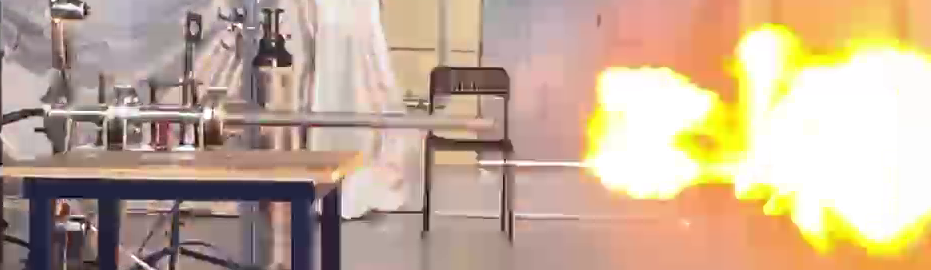
A propane-oxygen Pulse Detonation Engine (PDE) has been successfully developed, capable of high speed detonation upto 25 Hz.
Overview
A PDE has been developed in-house to study the effect of operational parameters such as propellant mass, spark timing, tube length on characteristic metrics of a PDE. One such identified characteristic is the Mach number of the detonation wave, allowing us to comment on the nature of the generated shock wave.
There are future plans to integrate this PDE into a Rotating Detonation Engine (RDE) also known as a Continuous Detonation Engine. RDEs provide continuous thrust due to the presence of a detonation wave rotating in an annular chamber, while propellant and oxidizer is fed continuously. There exist multiple advantages of RDEs over conventional jet engines, primarily the increased thermodynamic efficiency, compactness, no moving parts
Objectives
- Realize a laboratory scale PDE
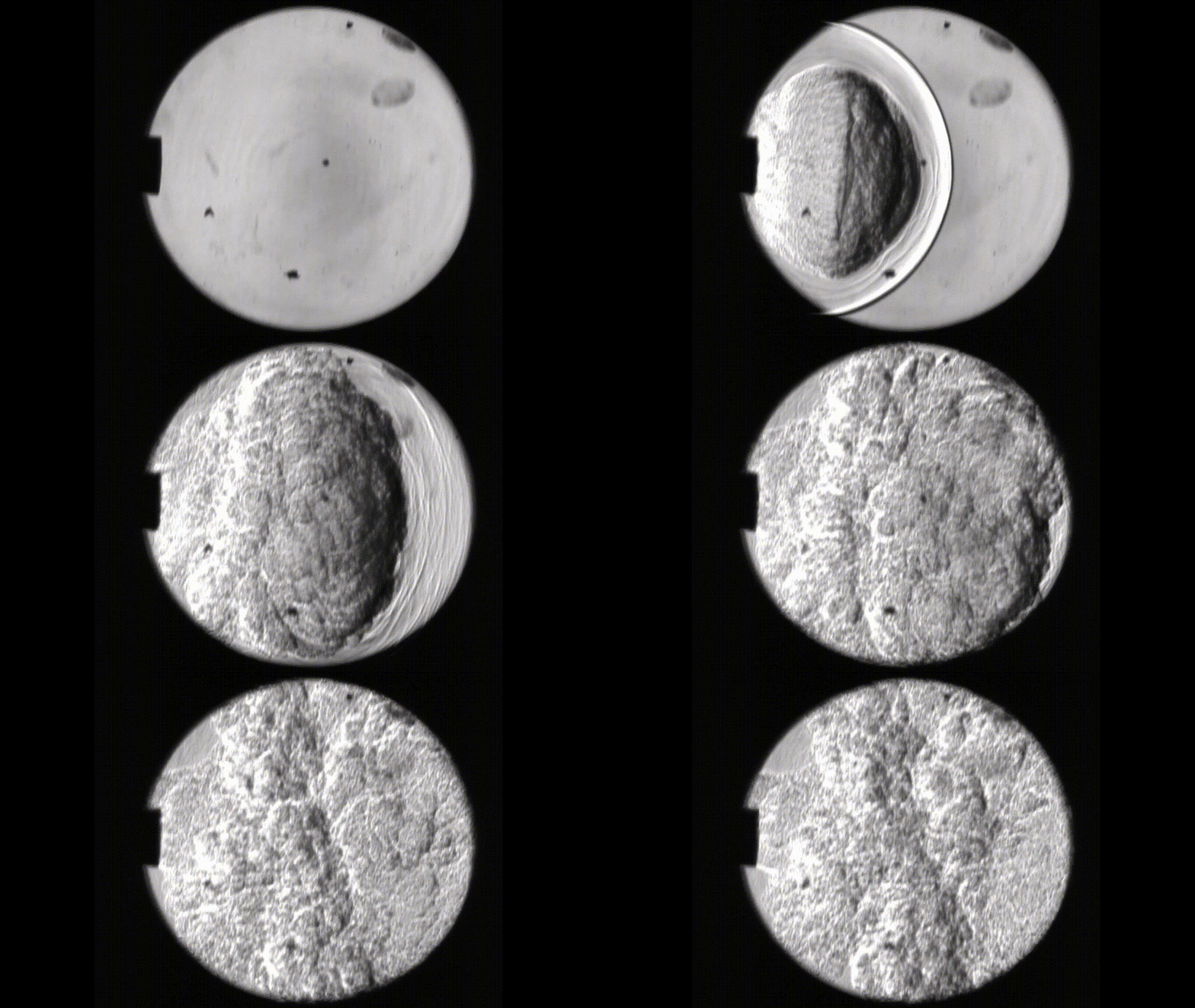
- Extract pressure, temperature and Schlieren data
- Integrate with a RDE
Methodology
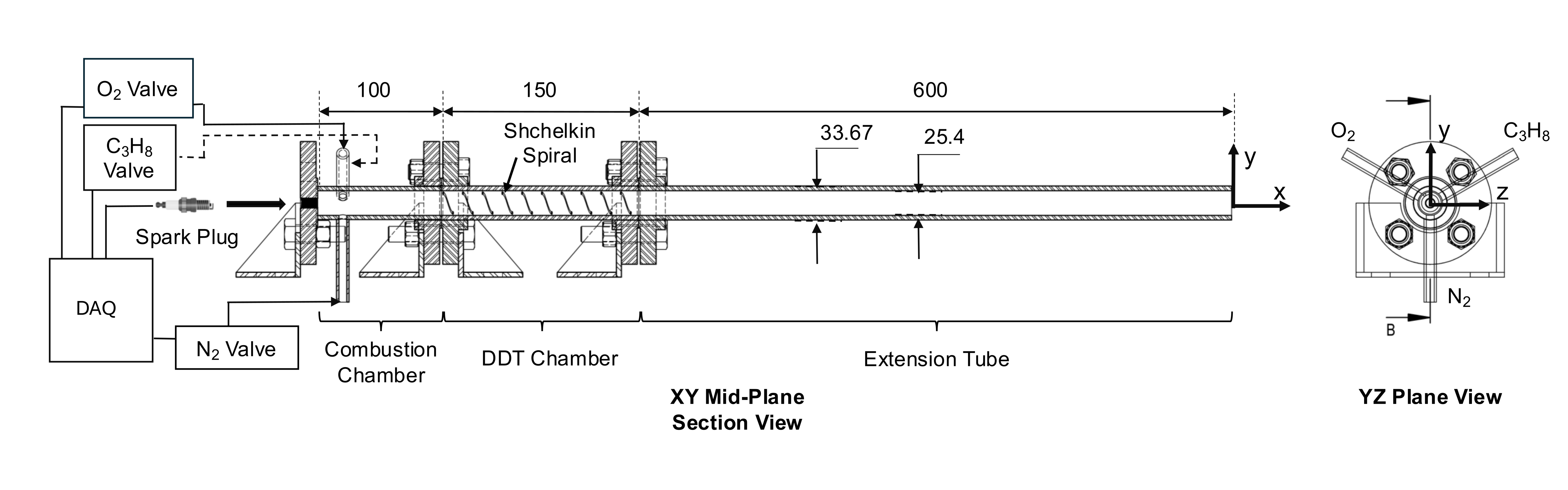
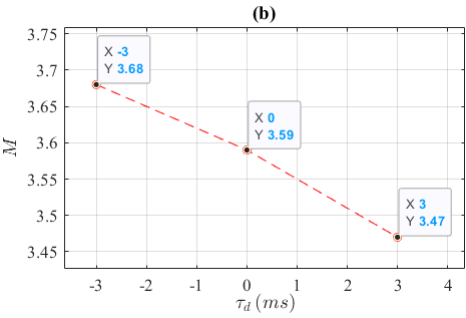
The engine setup consists of a combustion chamber, a DDT (Deflagration to Detonation Transition) chamber with a Schelkin spiral, and an extension Tube. Gases are injected radially through injection ports via independent solenoid valves, and a spark plug is used for ignition. The propellant injection and the spark delay timings varied over a range of 50 to 200 ms and –3 to +3 ms, respectively, to investigate the changes in Mach number at a fixed fill condition.
Technical Work
Initally the fuel-oxidized mixture was chosen to be propane-oxygen, due to easy availability and larger detonation cell size (safety considerations). Then the required pipe inner diameter was chosen by looking up the minimum diameter required for DDT from the Detonation Database. The propane-oxygen mixture was further diluted with nitrogen for a controlled detonation. This resulted in a minimum diameter of 24.7 mm and pipe length of around 500 mm (20 * D).
With the pipe inner dia in hand, the outer diameter was chosen by selecting a standard pipe size. The pipe has been divided into three chambers: combustion, DDT, extension. The combustion chamber holds the gas inlets, and the spark plug. A Schelkin spiral has been incorporated into the DDT chamber to accelerate the process and guarantee reliable detonation. The extension tube is present to simply achieve the target length of 25 D.
Results
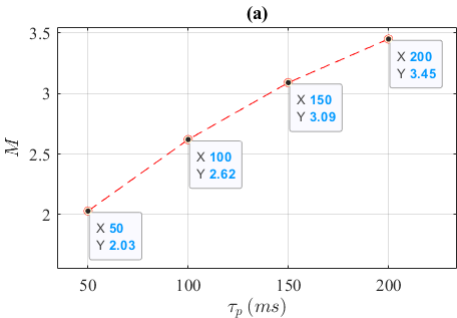
It was found that Mach number increased linearly with increase in propellant injection time, signifying more available run-up distance and hence a greater flame acceleration ahead of the shock. Increasing the delay in spark reduces the Mach number, denoting that there is some residual propellant flowing into the reacting mixture, reducing the vacuum buildup behind the detonation wave.
Tools
Acknowledgements
The project was funded by BUILD grant scheme provided by IIT Hyderabad
The PDE could not have been realized without the contributions of: Soumyajit Maji, Pranav Bavale, Manya Sachdeva, Sreehitha Tadavarthy, Sri Datta Krishna Gundlapudi, Srikanth Erry, Madhushankar Pillai, S.K. Karthick