Numerical Investigation on Effect of Coflow Width on Turbulent Plane Jets
Abstract
The influence of coflow width on the behaviour of a turbulent plane jet was numerically investigated. A RANS model was validated with experimental data [1] and was used to predict flow and entrainment behaviour for a Mach number of 0.9. The potential core was identified as a key region to characterise the flow behaviour. The primary objective of the investigation was to characterise the behaviour of potential core lengths with respect to the varying coflow width. Results were obtained for coflow velocity ratios of 0 and 0.16, both of which displayed expected asymptotic behaviour. Further investigations on the effect of varying the coflow velocity ratio in compressible flow regimes are ongoing.
Background
Turbulent jets frequently develop in practical applications such as engine exhausts, ventilation systems and environmental discharges. The behaviour of a jet is also affected by the presence of a main flow in the ambient fluid, i.e the coflow jet. A coflow system enables simulation of in-flight conditions and its effects on exhaust development, by providing more representative measurements of mixing, spreading, turbulence and self-similar flow characteristics. Existing rectangular-jet experiments are predominantly conducted in still ambient conditions, whereas practical exhaust plumes operate within moving external streams. Quantifying the influence of coflow on the development of rectangular turbulent jets is therefore necessary for realistic exhaust-plume prediction and accurate experimental predictions.
Experimental studies on plane jets that blow into parallel airstreams are limited in the literature, and focus on incompressible jets [1] [2]. Numerical investigations into flow physics were performed by Reichert and Biringen [3] and Ribault et. al [4] utilizing DNS and LES models respectively. Habli et. al [5] numerically investigated the effect of varying velocity ratio \(V_C\) on a turbulent plane jet. The current study aims to investigate the effect of varying coflow width (H) on a jet discharged with a velocity \(U_J\) into a parallel moving airstream of velocity \(U_C\) via a rectangular nozzle. The difference between the centerline \(U_{CL}\) and the jet velocities is denoted by \(U_0\). The ratio of the velocities is defined as \(V_C = U_C/U_J\). The objective is to find and quantify any asymptotic behaviour present in the flow, on varying H and \(V_C\).
Methodology
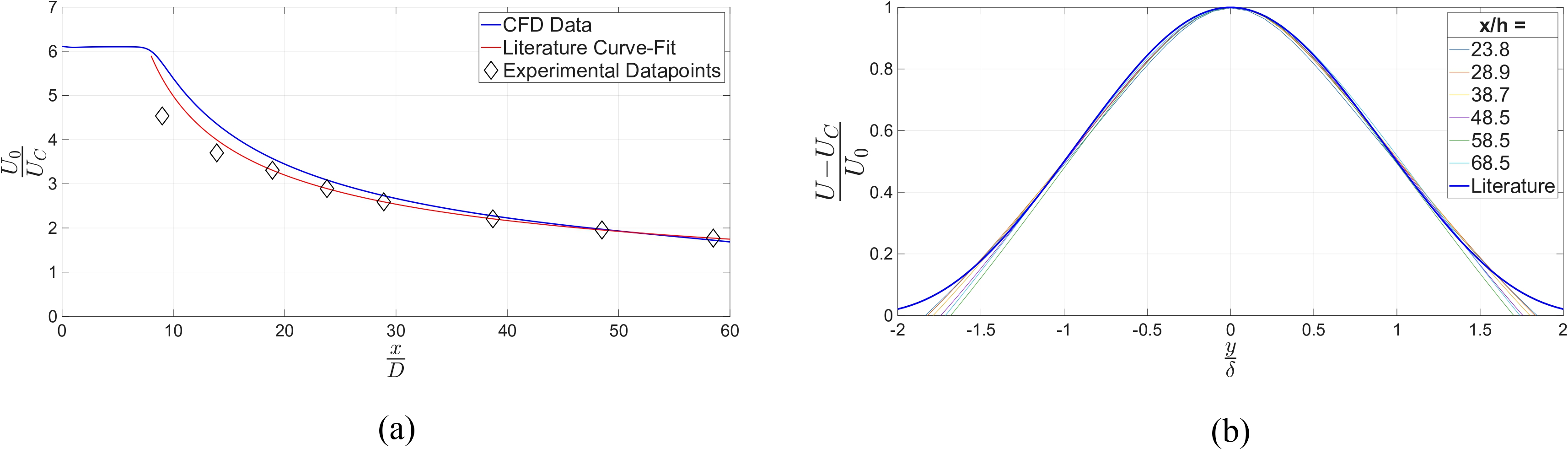
The present study investigates flow issuing out from a 2D rectangular nozzle, of width \(D = 9.525\) mm, using ANSYS Fluent. The model was first validated against experimental data [1], by comparing self-similarity profiles of the flow far from the nozzle exit as presented in Figure 2.
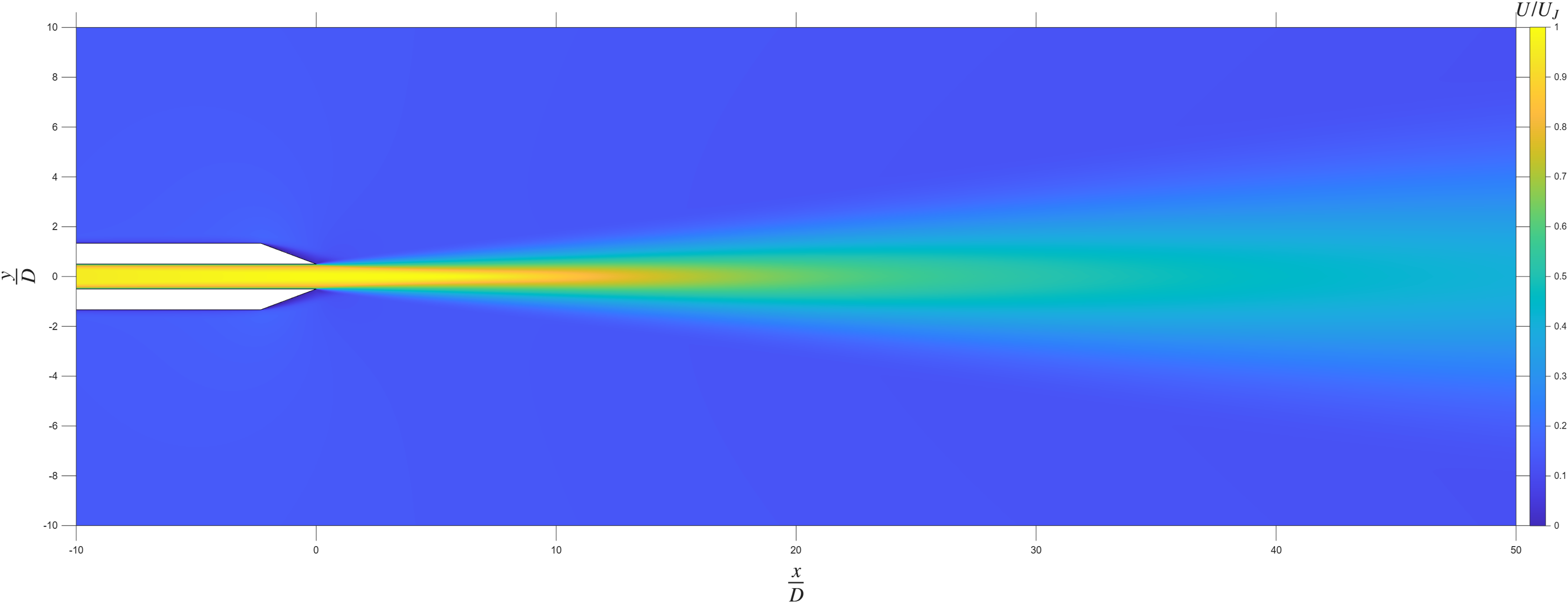
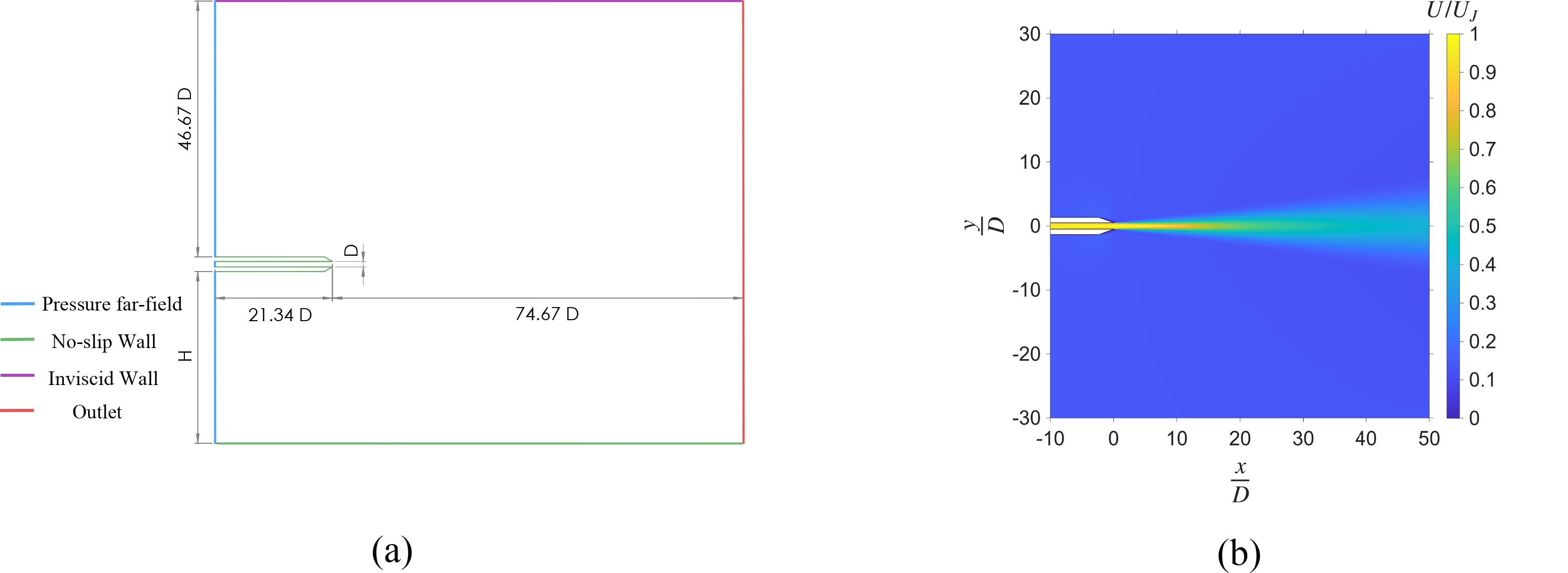
The simulation employs the Reynolds-Averaged Navier-Stokes (RANS) equations along with the shear stress transport (SST) k-\(\omega\) turbulence model to capture accurate flow behaviour. A structured quadrilateral mesh was generated using the "mapped" approach. The validation grid included 10 face zones with a cumulative 1,072,200 cells and 1,074,691 nodes. The first layer was set at a distance of 0.05 mm from the nozzle wall to accurately capture the boundary layer and mixing characteristics in all cases. The mesh was made denser near the nozzle exit and relatively coarser farther away, to optimize computational efficiency. Figure 1(b) presents the horizontal velocity data for the validation case.
To deal with compressible flow and the associated flow physics in the study, for \(V_C > 0\), the nozzle and coflow inlets were defined as "pressure far-field", and the outlet as "pressure-outlet". For \(V_C = 0\), the coflow inlet was defined as "pressure-outlet". The top and bottom boundaries were maintained as "inviscid" and "no-slip" walls respectively in all cases as seen in Figure 1.
Results and Future Work
Computational analyses were performed by varying H from \(40 D\) to \(5 D\) at a constant nozzle inlet Mach number of 0.9, for two cases of \(V_C = 0\) and \(V_C = 0.16\). Centerline mach number (\(M_{CL}\)) data was extracted and normalized against nozzle inlet mach number, (\(M_J\)), and plotted in 3-dimensions as a contour plot. The iso-contour of \(M_{CL}/M_J = 1\) displays the behaviour of the potential core decay. Figure 3 presents the behaviour of the potential core on varying \(H/D\) for the two cases respectively. The potential core length increases with increasing \(V_C\) as expected and seen by Habli et. al [5].
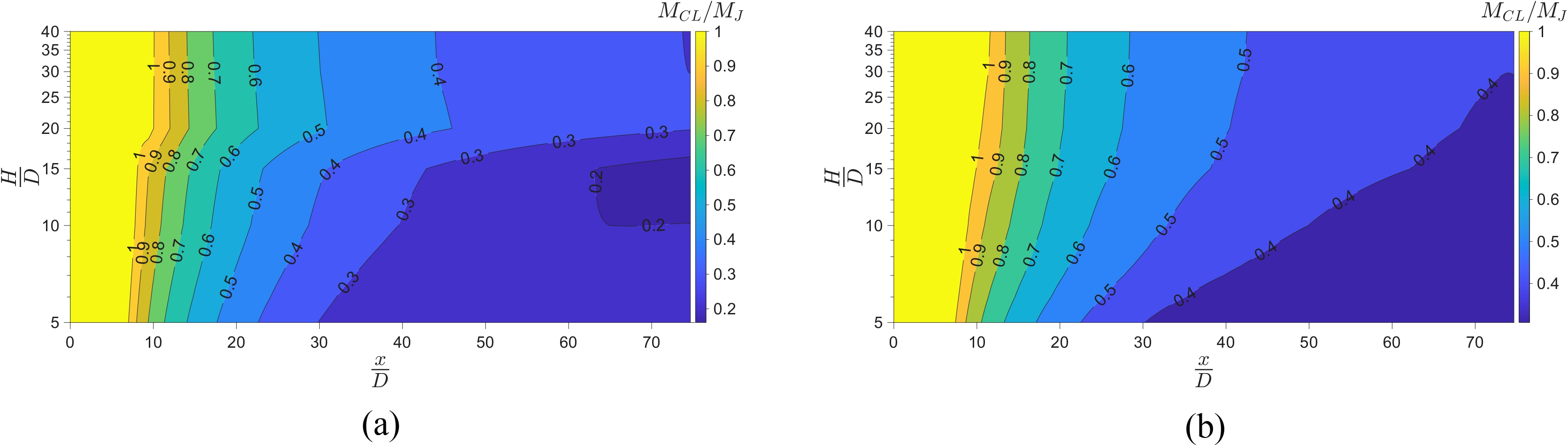
For \(V_C = 0\), where the jet is exhausted into ambient air, the flow achieves similarity at H greater than \(20 D\). Since \(V_C = 0\) mimics laboratory conditions, the nozzle exit must be placed at least 20 diameters above the ground, to accurately predict flow behaviour. On increasing \(V_C\) to 0.16, similarity is achieved much later, at H greater than \(30 D\). Further iterations focused on higher \(V_C\) values are ongoing.
Tools
References
- L. Bradbury Journal of Fluid Mechanics 23, 31-64 (1965)
- K. W. Everitt, A. G. Robins Journal of Fluid Mechanics 88, 563–583 (1978)
- R. Reichert, S. Biringen Mechanics Research Communications 34, 249–259 (2007)
- C. Le Ribault, S. Sarkar, S. Stanley Physics of Fluids 11, 3069–3083 (1999)
- S. Habli, N. Mahjoub Sa¨ıd, G. Le Palec, H. Bournot Computers and Fluids 89, 20–28 (2014)